HOME PAGE AND INTRODUCTION


CURRICULUM VITAE

WARFARE

LETTERS AFTER LOOK

MY PATIENTS

LETTERS FROM PATIENTS

NARRATIVE
IN PROGRESS


Warfare 


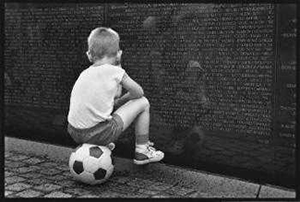
Vietnam Memorial Wall


"There is always inequity in life.

Some men are killed in a war and some men are wounded, and some men never leave the country...

Life is unfair."

John F. Kennedy in a press conference on March 21, 1962


What follows is now history. At that time, long ago and far away, it was
very much the present, and for many it can never be history, for they
can neither forget it nor confine it to their past. Pictures that speak
for themselves can perhaps provide the most honest and straightforward
view of what war can be. The text below is excerpted and paraphrased
from a letter to President Nixon sent during the summer of 1970 and
published in LOOK Magazine on July 28, 1970.


Prone Patient

"They have been in a war for years and years and they are quite debilitated
and decimated, and I don't think they are capable with any kind of
resistance of continuing this fight."

Spiro T. Agnew, Vice-President of the United States

Face the Nation (CBS-TV)

May 3, 1970


I had been practicing neurosurgery before my commissioning, and naturally
enough assumed I'd soon be in Vietnam. The army does move in strange
ways at times, and I found myself outside Tokyo for somewhat less than
two years. C-141 transport planes would pick up our patients at various
staging facilities in South Vietnam, wherever large enough airfields
were secure, and would fly them to the next hospital in the evacuation
chain. This meant the Philippines, Japan, occasionally Okinawa or the
United States. We were privileged at the 249th General Hospital in
Japan to see the majority of seriously injured patients with wounds of
the central nervous system, and thus had a fair overview of how things
were in military neurosurgery during this time.


I'm certain that many of our patients would not have survived long after
initial wounding in previous wars. It was not unusual for us to receive
gravely brain-injured men who had had their initial brain surgery
within one to two hours of wounding. Needless to say, because of the
tactical situation, it was sometimes impossible for a helicopter to
reach a man for twenty-four hours or more, but these isolated delays
were more the exception than the rule.


The 249th General Hospital, where I worked, was located in Asaka, just
northwest of Tokyo. It was a one-thousand-bed general hospital. We
received about one thousand wounded each month and either evacuated or
returned to duty slightly less than that number. The hospital gates
were manned by local Japanese security guards, and the hospital complex
was protected by a high wire fence.


Exposed Brain

"I would never send troops there."

Dwight D. Eisenhower

General, United States Army

New York City

June 8, 1952


Each ward in the hospital had its own medical flavor, and one could tell at
a glance which subspecialty was represented. We had a full service
hospital of course and did just about anything you could think of,
except for organ transplants.


The two neurosurgical wards had between sixty and eighty beds. and the
evacuation system kept our census fairly high. We had two fully trained
neurosurgeons, myself and a surgeon from southwest of Worcester, Mass.
All our patients had something wrong with one part or another of their
nervous system--usually something was missing after injury. Although we
usually kept patients between five days and several weeks, the turnover
could be quite brisk. During times of stress - for instance, during Tet
when the enemy was acquiring its psychological victory--we continued
our patients' evacuations to the United States as briskly as possible.
I would usually write out the patient's discharge and transfer summary
at the same time that I did his admission history and physical.


May I suggest that if another 'Tet-like' period occurs in this non-war, it
would save a lot of time and effort if patients were sent directly back
to the United States from Southeast Asia rather than to Japan.
Undeniably, Japan is a wonderful land, and its culture is fascinating,
but so few of our patients really enjoyed the time they spent there.
Mostly, they wanted to know why they had come to Japan, and what were
they doing in that part of the world. I never really did find the
answer to that question in my one year, eleven months and twenty-eight
days of active duty, and must further confess that I never heard a very reasonable explanation of what any American was doing over there.


Helicopter


"Vietnam has been good for the Marines, and the Marines have been good for Vietnam."

Herman Nickerson, Jr.

Lieutenant General, U.S. Marine Corps

Danang, South Vietnam

March 9, 1970


I wonder if you ever got that report from the costs analyst who visited
with us in Japan. He came from the Department of Defense. I tabulated a
list of patients on our ward about that time, and tried to determine
from a medical point of view what percentage actually benefited in
their treatment by coming to Japan instead of taking an extra five or
six hours to go directly home. We had somewhat more than sixty patients
on the two wards then, and I could honestly say that two or perhaps
three of them might have benefited by not taking the more direct route.
I'm not quite certain of the final figure the Pentagon was given, but I
was told that the costs analyst received from our medical command in
Japan the statement that fifty to fifty-five percent of our men
benefited from their time with us. It is interesting to see how the
assessment of the situation varies depending from what level in the
chain of command you are watching.


Many of our patients with severe degrees of brain injury showed very little
resentment against the circumstances that found them in Vietnam . In
one sense, the more severely brain-injured were fortunate in that they
were less aware of their deficits and certainly experienced less
anguish. I doubt the same would hold true of their families.


I was never entirely satisfied with treating one particularly severe type
of problem. Briefly, the difficulty arises because such a large amount
of nose, middle face, and base of skull are destroyed, along with brain
substance. Infection and continued leaking of spinal fluid were most
difficult to manage. I do not think we have found an ideal way yet of
treating this type of injury.


The loss of tissue in land-mine injuries was rather common. Such wounds
were extensively debrided in Vietnam, and after five to seven days of
care, they were either further debrided of dead and necrotic tissue or
sutured. Many of our men had multiple-fragment wounds from rockets,
land mines, booby traps or mortars. When the brain or spinal cord was
also damaged, they'd be assigned to our neurosurgical service and we'd
have an opportunity to extend and broaden our general surgical experience with caring for these associated injuries.


Carol


"I have never been more encouraged in my four years in Vietnam."

General William C. Westmoreland

Commander, United States Forces in South Vietnam

Washington D.C.

November 15, 1967


I must sadly confess that from my vantage point, we weren't winning very
much. Clearly, it was a long time ago that we were told we'd soon be
done with it. We were assured and reasssured that victory was almost in
sight. Now, I wouldn't presume to contradict men who were my military
superiors, and I wouldn't for a moment question the statements of
either the elected representatives of the South Vietnamese people, or
of our own field commanders and generals in the Republic of Vietnam,
but I would in all humility submit that these boys and men who came
under my care were not cheered by the thought that we were winning.
These boys felt that they had lost; and, of course, in a simplistic
sense, I guess that they had lost -- an arm, a few legs, some brain, a
little bone, a kidney, a lung or spleen, perhaps some liver. I must
sadly observe that despite our cheery casualty statistics that we've
killed fifteen times as many North Vietnamese and Vietcong as they've
killed of us, the fact remains that many of my patients felt that they
had lost.


I guess it's difficult to avoid giving you the impression that I'm sort
of an anti-war kind of person. I admit that I didn't feel too strongly
one way or the other before putting on my uniform. It really took very
little time to realize that there were better ways of dying for one's
country than the ways we devised for our younger brothers and
neighbors. Not all my patients were draftees or short-termers who were
anxious to serve their hitch and get out; we often had patients on the
ward who were career soldiers, and at times we even had some officers.


Open Skull

"He was a farm boy who had worked in the fields, and his family just didn't believe sunstroke killed him.

"I checked into it, and the Pentagon reported his face and body were
reddened by the sun while he waited three hours to be evacuated by
helicopter from combat.

"Finally they acknowledged he was waiting to be evacuated because he had three
bullet holes in him. And they call that an incidental death; Well, they changed it.

"The number of combat killed and wounded have become so great ... they are
trying to hide it...a clumsy effort to deceive the public about
casualties in this most unpopular and undeclared war."

Stephen M. Young

Senator from Ohio

Washington. D.C.

April 29, 1969


My own ward was fairly characteristic. Comatose patients certainly can be
seen wherever much neurosurgery is being done, but we had a rather
large volume of them. The Army cared for its paraplegic and
quadriplegic patients with Stryker frames and CircOlectric beds that
provided movements and changes of position the men could not provide
themselves. In our ward, we had quite a bit of difficulty trying to
decide who should continue evacuation back to the States and who should
return to combat. I'm glad to hear that the burden of making this
decision has been eased, and that all patients who reach Japan are now
able to continue home. I must confess this seems quite reasonable; the
other way seemed somewhat cruel -- almost like sending men back to
combat because they hadn't been hurt badly enough the first time.


I'd like just once more to reemphasize that I do not intend this letter as
criticism or expression of disapproval. Why, you weren't even my
Commander-In-Chief during most of this time, and the President who
preceded you was being reassured that the end was just around the
corner, that the enemy was on his last legs, that we had just to buckle
down a little longer and the coonskin would be on our wall, etc.


I was happy to read not long ago that the Army Chief of Staff has stated
that the Vietnam War has technologically been a great success. I
assumed he must have had in mind such developments as a MUST unit. This
is a Medical Unit Self-contained Transportable and will certainly be
useful in situations where a small hospital must be rapidly set up near
a large disaster area. If I understand the concept correctly, the idea
is to send the hospital to any area where large numbers of casualties
are being generated. I must apologize at this point for a temporary
diversion.


I had never before thought of sick or wounded people as being generated.
It's a concept I learned during my indoctrination period at Fort Sam
Houston in Texas. You will agree, surely, that it is a modern way of
thinking about these problems. It's clearly much nicer to sit in a
conference and hear about five hundred or five thousand casualties
being generated in a given situation. It's a much nicer way to think of
large groups of people in this manner, somewhat like electricity being
generated at some power plant or other. Well, in any event, I just
never could get it into my own head, or discipline myself to think of
my patients in this fashion -- being generated here, stored there,
transported, re-stored, etc. This probably accounts for my hesitancy in
being more outspoken with that costs analyst from the Pentagon. I just
couldn't convince him that we were dealing with patients, not packages.


I must confess that despite the nice commendation the country has given
me, and despite your enthusiastic support during this conflict, I
didn't ever come to feel that being part of the Army team was really my
cup of tea. I just never managed to get into the spirit of it.


This letter has far exceeded my original intention of just jotting down a
quick note; but if it's provided you with any information or a
viewpoint somewhat different from what has reached you through more
standard and orthodox channels, then it has certainly been worth my
time. I do hope I have not bored you, either, with my thoughts or these
photographs.


When I left active duty and was being discharged through Oakland, I was
gratified to see a welcoming sign in the corridor. I regretted only
that my own patients who had been evacuated through medical channels
were unable to see this concrete expression of their nation's gratitude.


Welcome Home

"It simply does not matter very much for the United States, in cold,
unadorned strategic terms, who rules the states of Indochina. Nor does
it matter all that terribly much to the inhabitants. At the risk of
being accused of every sin from racism to communism, I stress the
irrelevance of ideology to poor and backward populations."

J. William Fulbright

Chairman of the Senate Foreign Relations Committee

Washington. D.C.


I appreciated the opportunity of visiting Japan and of broadening my
medical experience during that time. I regret that we lost so many men,
not only in Vietnam, but also in our overseas hospitals. Some of the
casualties were more difficult to retrieve or repair than others.
Caring for the wounded is indeed a privilege; but I was never able to
convince myself that they had been wounded for any good end. They were,
after wounding, and I'm certain before wounding also, the finest men
I've seen. But I cannot help but point out my feeling that this war was
unworthy of them. They gave too much in that far-off place -- and we
should not have sent them there.


I know that you deplore this conflict as much as I, perhaps for different
reasons. I did hope that sharing these few pictures and thoughts with
you would in some way explain why I felt compelled to submit my
resignation as I did, rather than to extend my time in the Army. There
are, happily enough, younger men now available to carry on the
neurosurgical tradition in and after combat. I do hope that they are
made of stronger stuff inside than I, and that their tours of duty will
not remain in their minds quite so indelibly as has mine.


Knowing how the military operates, I'm certain that neither you nor your
predecessors have had the opportunity to see these scenes. We who were
fortunate enough to be brought into active service as two-year doctors
have, of course. When we reported for duty, the threats that our orders
would be changed for Vietnam if we didn't extend for a third year
seemed somewhat hollow. None of our group being indoctrinated at San
Antonio was cowed. Things evidently later changed, for we had several
men appear in Japan this past year after having extended their tours of
duty for that very reason. I must admit that I was never terribly
impressed by the personnel procedures or procurement policies of the
Army. But if the courts allow this practice to continue, then I suspect
the military may have found a way to get one-and-one-half times as much
wear out of this former group of two-year doctors. I congratulate your
planners.


I really had hoped to send you this note while I was still on active
duty, but we were somewhat busy most of the time, and my colleagues and
superiors cautioned me that it might be more appropriate to allow a
seemly interval to pass before trying to record my recollections for
you. I'm afraid I'm leaving out a great deal that seemed important to
me at the time, but I'm nevertheless able to recall a few glimpses of
what was occurring. I had been told that if I waited long enough,
perhaps the war would go away. I did wait, but it didn't seem to go
away at all...


It's hard to believe in war if you take the preceding or following seriously.


Here are six Pictures without Words that appeared in the LOOK article:


Look 1


Look 2


Look 3


Look 4


Look 5


Look 6